
When the garden is designed together with the house, planting can do work that would otherwise fall to walls, roofs and machines: shade on terraces, privacy between neighbours and cooler air around the rooms. In Guanacaste, native dry forest species also need far less water in the dry season, which matters more now that several ASADAS have stopped giving new connections.
What does landscaping add to the architecture of a house?
It gives the outdoor areas their shade, privacy and order. On the Guanacaste coast most of daily life happens outside, on terraces, by the pool and on the paths between them, so the garden is as much a part of the house as the living room.
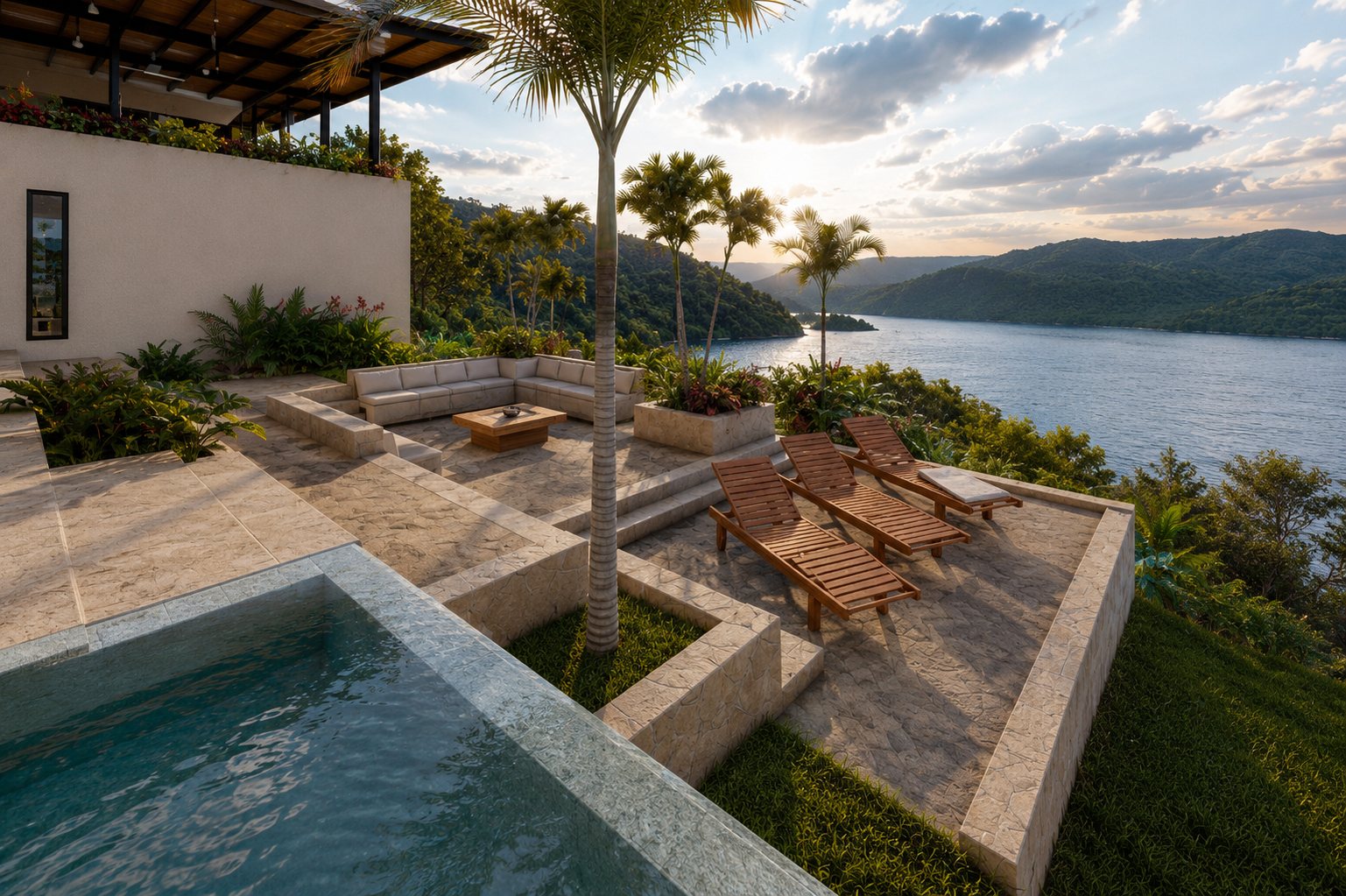
A plant that shades a terrace can replace part of a roof. A row of shrubs can take the place of a wall between two lots. Trees on the west side cut the afternoon sun before it reaches a facade. These are design decisions, and they work best when they are made on the same drawings as the house, before the positions of doors, windows and terraces are fixed.
When the garden comes afterwards, it usually has to fit around what is already built. Then the planting decorates instead of solving.
Why plant native species of the dry forest?
Because they are adapted to the climate: months of heavy rain followed by months with almost none. Once established, they need little irrigation and recover by themselves when the rains return.
Native planting also brings the fauna of the area back into the garden. Birds, butterflies and hummingbirds come to feed, and the garden stops looking like an island within its surroundings. Near protected areas this matters twice: the planting has to sit well with the forest next to it.
This does not rule out ornamental species. We use them where a garden needs colour or density, usually close to the house and the pool, and we keep the native species for the edges and the larger areas. The mix depends on how much water the lot has and how much maintenance the owner wants.
How does planting create shade around the house?
By placing trees where the sun hits hardest, which on the coast means the west and the areas people use in the afternoon. A tree over a terrace or a path lowers the temperature underfoot and around it.
The quickest shade is the shade already on the lot. Mature trees take years to grow, so on every project we survey the existing trees before placing the house, and we try to keep the ones that give shade or frame a view. New trees fill the gaps, but they need time.
Pergolas with climbing plants work while the trees grow. They give shade in the first season and can be left in place once the trees take over.
How much water does a tropical garden need in the dry season?
It depends on the species. A lawn with tropical plants needs regular irrigation through the dry season; a garden of native dry forest species needs very little once established.
We usually divide the garden into zones by water use. The areas nearest the house and the pool get the lusher planting and the irrigation. The entrance, the edges and the larger areas get native species that survive the dry season with little help. The irrigation plan follows those zones, so water goes where it is needed.
| Garden zone | Planting | Irrigation |
|---|---|---|
| Around the house and the pool | Lusher tropical planting, some ornamental species | Regular, on its own irrigation zone |
| Entrance and edges | Native dry forest species | Little once established |
| Larger areas and existing trees | Native species, trees kept from the lot | Minimal |
This is now a practical question as well as an environmental one. The ASADAS of Playa Grande, Matapalo and Avellanas are in technical non-feasibility and are not giving new water availability letters. On lots that depend on a condominium well or on a limited connection, a garden that needs less water is the one that will stay green.
When should the landscape design start?
At the site analysis, before the house is drawn. The landscape architect reads the same things as the architect: sun, wind, slope, existing trees and where the water runs when it rains.
Drainage is the clearest example. In a mountain zone like Arenal, the ground drains well, and the answer is a good network of drains laid away from the house and following the slope. That network shapes the garden, so it has to be planned with the foundations, not after them.
Lighting is another. Near the beach in Playa Grande, within the maritime terrestrial zone, SINAC requires red lighting so the garden does not disturb nesting turtles. Low bollards along the paths and lights that point down keep the garden usable at night without lighting the sky. Our landscape design service covers planting, paths, lighting and irrigation as one plan.
What we've seen on our projects
- Villa Viva, Playa Grande, 2026. The dry forest trees on the lot were kept, and the hammocks now hang between them. New palms were planted around the lawn. Stepping-stone paths on gravel, edged with river stone, lead to the trees and to a sand volleyball court; at night low bollards mark the paths and uplights pick out the palms.
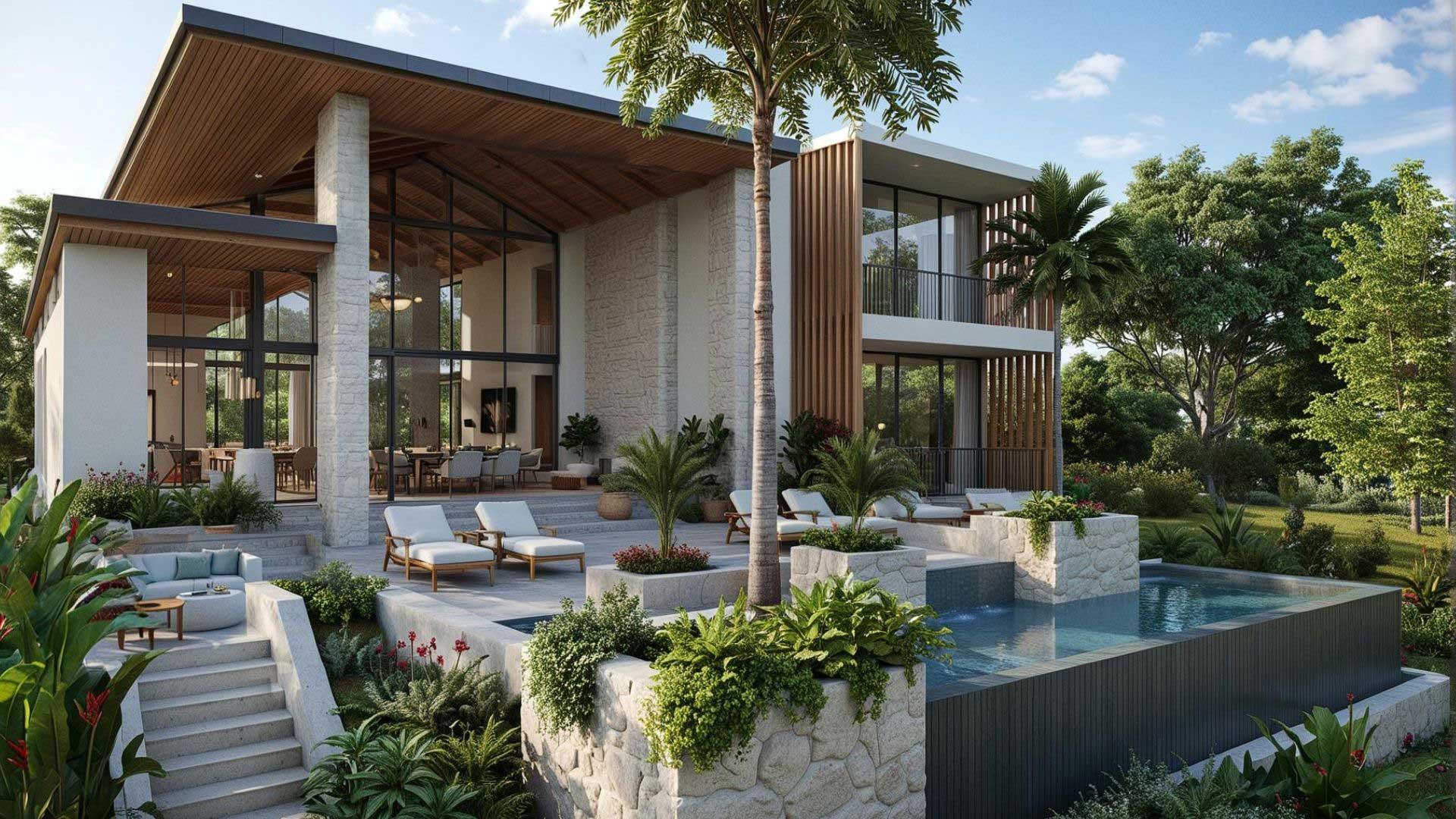
- SP House, Tamarindo. A garden arranged around a pool, planted with native plants and trees chosen to reduce water use. The planting frames the outdoor living areas, so the garden gives each area its own edge.
- Relajarse, Playa Grande. A boutique lodging inside Las Baulas Marine National Park. The planting mixes native and ornamental species to give each room privacy without breaking with the protected area around it, and stone and sand paths connect the rooms.
All three are in Tamarindo and Playa Grande, where the dry season is long and the water situation is the tightest on the coast.
Frequently asked questions
- SINAC, Sistema Nacional de Áreas de Conservación
- ASADAS, asociaciones administradoras de acueductos comunales