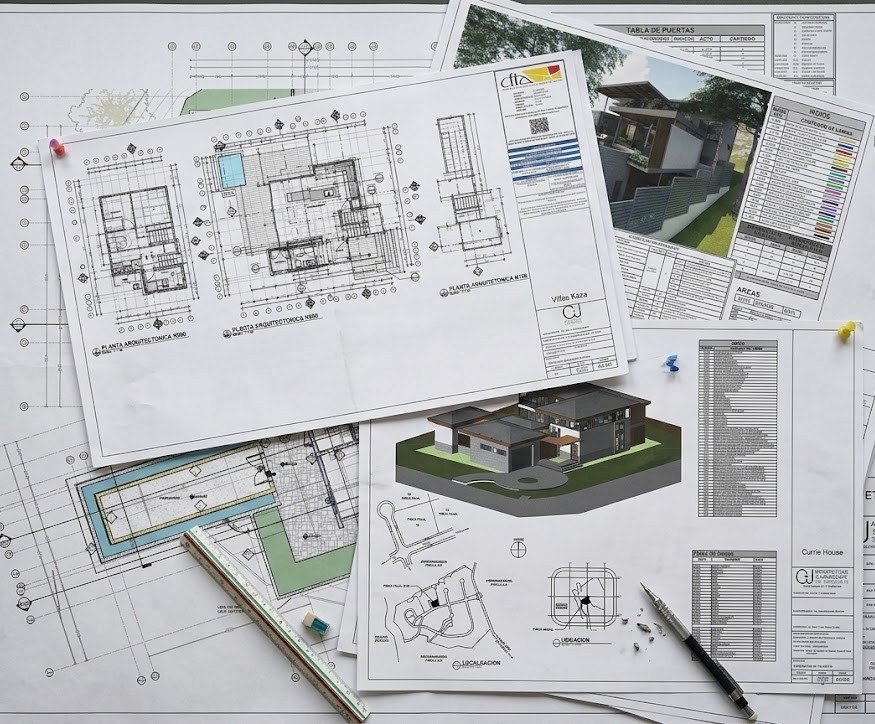

In Costa Rica a house takes 5 to 9 months from the start of design to the building permit, depending on its size and complexity. The first step is the water availability letter, because no project can go ahead without it. Then come the design, the condominium committee if there is one, the CFIA, the Ministry of Health and the municipality.
What are the steps to get a building permit in Costa Rica?
No project can be built without a valid water availability letter. It is the first thing we check on any lot, before design starts, because where the letter cannot be obtained the rest of the process cannot begin.
After the water letter, the approvals follow a fixed order. The plans are designed and signed, reviewed by the condominium committee when the lot is inside one, registered with the CFIA, reviewed by the Ministry of Health for houses above 300 m², and approved by the municipality. Before the first day on site, the owner also takes out workers' risk insurance with the INS, the national insurance institute.
| Step | Who approves it | Usual time |
|---|---|---|
| 1. Water availability letter | AyA, an ASADA or the condominium | About 1 month with an ASADA |
| 2. Design and permit drawings | The studio and the owner | 4 months minimum |
| 3. Design committee (condominiums only) | The condominium | 3 weeks to 1 month |
| 4. Registration and review of the plans | CFIA, through its APC platform | About 30 days |
| 5. Health review (houses above 300 m²) | Ministry of Health | About 3 weeks |
| 6. Building permit | Municipality | 2 to 4 weeks in Santa Cruz, 30 days in Tilarán |
Why is the water letter the first step?
Because without it there is no permit, and on part of the coast it cannot be obtained today. Every lot needs a valid water availability letter, and the municipality asks for it in the permit file.
On the Guanacaste coast, where we work, who issues the letter depends on the zone.
| Zone | Water supplier | Situation in 2026 |
|---|---|---|
| Tamarindo centre | AyA, in most cases | Particular areas are checked case by case |
| Playa Grande, Matapalo, Avellanas | Local ASADAS | Technical non-feasibility: no new letters, no date to resume |
| Condominiums in Playa Grande, Reserva Conchal, Mar Vista | The condominium's own well | The condominium manages availability for its lots |
| Flamingo, outside condominiums | ASADA de Brasilito | Normal procedure |
| Potrero | ASADA de Potrero | Normal procedure |
| Hacienda Pinilla | ASADA Malinches de Pinilla | Connection after committee approval |
| Ladera del Mar, Papagayo | The condominium | The construction committee issues the letter |
When the procedure with an ASADA runs normally, it takes about a month: the request is received, reviewed by the board and approved or rejected. The meters are delivered only once the full building permit is issued. Where the ASADA is in non-feasibility, owners have already received refusals. If you are buying a lot in Tamarindo or Playa Grande, ask for the water letter before you sign.
How long does it take from the first sketch to the permit?
From 5 to 9 months, depending on the size and complexity of the project. We need at least 4 months for the design itself, and the committee, the CFIA, the Ministry of Health where it applies and the municipality take the rest.
Investment projects tend to reach the permit sooner than houses where the owner will live. The reason is the number of change rounds: a family home goes through more of them, and each round moves the drawings back a step. We shorten the total by overlapping stages. While the plans are under review, we start the interior design, so the owner does not wait for the permit to make those decisions.
The municipal review is shorter than most people expect. The CFIA review has a term of about 30 days and the Ministry of Health takes about 3 weeks. In Santa Cruz, the municipality for most of our projects on the coast, the procedure takes 2 to 4 weeks. In Tilarán, the municipality for our projects in Arenal, it is about 30 days.
Which studies can a lot need before the plans are submitted?
It depends on the lot and the size of the project. Most houses need only the standard set of drawings and a soil study, but some sites add studies that have to be ready before the CFIA registration.
Soil and wastewater
The soil study costs around USD 1,400. It includes the infiltration test, which measures how well the soil absorbs and drains water and defines the septic system, following Decree 42075-S-MINAE on wastewater. If the project includes a treatment plant, that plant needs its own permit.
Environment and trees
Projects that can have a significant effect on the environment need an environmental viability review from SETENA. Removing trees requires a tree-cutting permit.
Roads and urban planning
Lots on a national route need a road alignment from MOPT, the Ministry of Public Works. The INVU alignment confirms compliance with urban planning rules.
Coast and protected areas
The first 200 m from the high-tide line fall under the Maritime Terrestrial Zone Law, with a special regime; foreigners cannot hold full ownership there. In Avellanas we check this lot by lot. In Playa Grande, lots under the Las Baulas Marine National Park have a minimum size of 1,500 m², and near the beach SINAC requires red lighting so the lights do not disturb nesting turtles. These rules shape the design, so we check them in the site analysis, before drawing.
Which documents does the municipality ask for?
The municipality asks for the approved plans and a file that proves who owns the land and that it can be built on. The list is set nationally, so it is much the same in every municipality.
- Building permit application form and construction statistics form
- Plans approved by the CFIA and the contract registered with the CFIA
- Water availability letter
- Land use certificate
- Current literal certification of the property and the cadastral plan
- ID of the owner or legal entity documents, and a partners' agreement if the land has more than one owner
- Municipal taxes paid to date and an employer certificate from the Social Security fund (CCSS)
- Environmental report, when the project needs one
We prepare and submit this file as part of our permitting service. The owner signs and supplies the property documents; we handle the rest.
How does a condominium design committee fit into the process?
The committee reviews the design before anything goes to the CFIA. Every committee we work with asks for the complete permit set: architecture, electromechanical and structural drawings, with plans, sections and elevations.
A review usually takes 3 weeks to a month. Fees and rounds vary by condominium.
| Condominium | Fee per review | Rounds |
|---|---|---|
| Reserva Conchal | 2,000 USD | Varies |
| Hacienda Pinilla | 1,000 USD | Varies |
| Ladera del Mar, Papagayo | 250 USD | Two |
Because the committee asks for complete drawings, it cannot be used as an early check on a sketch. We build its time into the schedule from the start.
What does the permit process cost?
The main costs are percentages of the construction cost, not fixed amounts. The final figure depends on the size and value of each project.
| Item | How it is calculated |
|---|---|
| CFIA registration | 0.256% to 1% of the construction cost |
| Municipal construction tax | 1% of the construction cost |
| INS workers' risk insurance | About 3.71% of the labour cost |
| Soil study | Around USD 1,400 |
Design fees are not part of this list. We calculate them on the estimated construction cost and give the figure when we quote a project.
What we've seen on our projects
- Casa El Sueño, Arenal. The house looks over the lake and sits outside the 50 m strip along the shore. In Tilarán, the municipal procedure takes about 30 days. See our notes on building in Arenal.
- Casa Vida, Hacienda Pinilla. The committee took about a month, with two rounds. Every round was on the full permit set. More on building in Hacienda Pinilla and Avellanas.
- Ladera del Mar 103, Papagayo. The committee review came back almost overnight. The project is in process.
Our water cases, including the Casa El Sueño well, are in the article on water for building lots in Guanacaste.
Frequently asked questions
- AyA, Instituto Costarricense de Acueductos y Alcantarillados
- ASADAS, asociaciones administradoras de acueductos comunales
- CFIA, Colegio Federado de Ingenieros y de Arquitectos de Costa Rica
- Ministerio de Salud de Costa Rica
- Municipalidad de Santa Cruz, Guanacaste
- SETENA, Secretaría Técnica Nacional Ambiental
- INVU, Instituto Nacional de Vivienda y Urbanismo
- SINAC, Sistema Nacional de Áreas de Conservación
- Ley 6043, Ley sobre la Zona Marítimo Terrestre
- Decreto Ejecutivo 42075-S-MINAE (aguas residuales)