
Research over the last forty years links contact with nature to lower stress hormones, lower blood pressure, better attention and better mood, and daylight to better sleep. Most people now spend around nine tenths of their time indoors. A house cannot replace a walk in the forest, but it can decide how much light, green and open air reach daily life.
Why does contact with nature matter for health?
For most of human history people lived outdoors, under daylight and among plants and animals. The biologist Edward O. Wilson called the inclination to seek that contact biophilia, in a book of the same name published in 1984. The idea has since moved from theory to measurement: researchers now test it with blood samples, heart rate, brain scans and population records.
The contrast with how we live today is large. In the National Human Activity Pattern Survey, a study of more than 9,000 people in the United States, respondents spent on average 87% of their time inside buildings and about 6% inside vehicles. That leaves little more than an hour and a half a day outdoors, and for many people it is far less.
What have the studies found?
A view of trees. In 1984 the journal Science published a study by Roger Ulrich on patients recovering from gallbladder surgery in a Pennsylvania hospital. The 23 patients whose windows looked onto trees had shorter hospital stays, took fewer strong painkillers and received fewer negative notes from nurses than 23 matched patients whose windows faced a brick wall. It is one of the most cited studies in hospital design, and it measured only a view.
A walk in the forest. Japanese researchers studied shinrin-yoku, or forest bathing, in 24 forests across the country with 280 participants. Compared with walking and sitting in a city, time in the forest was associated with lower cortisol, the main stress hormone, lower pulse and blood pressure, and more activity of the parasympathetic nervous system, the part that governs rest. In a separate study led by Qing Li, a three-day forest trip raised the activity of natural killer cells, part of the immune defence, and the effect lasted more than seven days. A city trip with the same level of activity did not.
The mind. At Stanford, Gregory Bratman and colleagues compared a 90-minute walk in a natural area with the same walk along a busy road. After the nature walk, participants reported less rumination, the repetitive negative thinking linked to depression, and showed less activity in a brain region associated with it. The urban walk had no such effect. At the University of Michigan, Marc Berman and colleagues found that walking in nature, or even looking at pictures of it, improved performance on attention tests.
How much is enough. A study of almost 20,000 people in England, led by Mathew White and published in 2019, found that those who spent at least 120 minutes a week in nature were significantly more likely to report good health and wellbeing than those who spent none. The benefit peaked between 200 and 300 minutes a week, and it did not matter whether the time came in one visit or several short ones.
The long view. A review of 143 studies by Caoimhe Twohig-Bennett and Andy Jones, published in 2018, found that more exposure to green space was associated with lower cortisol, lower heart rate and lower diastolic blood pressure, among other outcomes. In Denmark, researchers followed 943,027 people from birth: those who grew up with the least green space around their homes had up to a 55% higher risk of developing a psychiatric disorder later in life, after accounting for other known risk factors.
| Study | What was measured | What it found |
|---|---|---|
| Ulrich, Science (1984) | Recovery after surgery, view of trees vs. a wall | Shorter stays and fewer strong painkillers |
| Park et al. (2010), 24 forests in Japan | Cortisol, pulse, blood pressure | All lower in the forest than in the city |
| Li et al. (2008) | Immune activity after a forest trip | Higher natural killer cell activity, lasting over 7 days |
| Bratman et al., PNAS (2015) | 90-minute walk, nature vs. road | Less rumination and less activity in a related brain area |
| White et al., Scientific Reports (2019) | Weekly time in nature, 19,806 people | 120 minutes a week linked to better health and wellbeing |
| Engemann et al., PNAS (2019) | Green space in childhood, 943,027 people | Up to 55% higher risk of psychiatric disorders with the least green space |
Most of these studies are observational: they show associations, and the authors themselves point to limits in study quality and to factors that are hard to separate, such as income or physical activity. The consistency across countries, methods and decades is what gives the body of evidence its weight.
What do we lose when we spend too little time outdoors and in the sun?
Sleep and the body clock. Daylight is the main signal that sets the internal clock. In a study at Northwestern University, office workers with windows at their workstations received more light during the week, slept longer and reported better sleep quality and more vitality than colleagues in windowless spaces. The authors concluded that office design should give more weight to daylight.
Mood. In Melbourne, Gavin Lambert and colleagues measured the production of serotonin, a chemical messenger linked to mood, directly in the brain of 101 men. It was lowest in winter and rose with the hours of bright sunshine on the day of the measurement. In a Canadian psychiatric unit, patients with severe depression who were placed in the sunny rooms stayed an average of 16.9 days, compared with 19.5 days for those in darker rooms.
Vitamin D. The skin produces most of the body's vitamin D when it is exposed to the sun. In Sweden, a study followed 29,518 women for 20 years and found that those who avoided the sun had roughly twice the mortality rate of those with the most sun exposure. The authors frame the result for a country with weak sunlight, where very restrictive sun advice may do more harm than good.
Children's eyes. In a trial in 12 schools in Guangzhou, China, adding 40 minutes of outdoor activity to the school day reduced new cases of myopia over three years to 30.4% of children, compared with 39.5% in schools that kept their usual routine.
The writer Richard Louv coined the term “nature-deficit disorder” in 2005 to describe these costs, especially in children. It is not a medical diagnosis, but it names something the studies keep measuring: time away from nature and daylight shows up in sleep, mood, attention and the body.
How much sun is right in Guanacaste?
The research on sunlight comes mostly from northern countries, where the sun is weak for months. In Guanacaste the opposite is true: the sun is intense all year, and long exposure at midday carries a real risk of burns and skin damage. The benefit here comes from regular, moderate contact: morning light, time outdoors in the shade, and daylight inside the house. How much direct sun each person needs is a question for their doctor.
This is where architecture has a role. A house in the tropics can deliver daylight without heat and time outdoors without harsh sun, through eaves, shaded terraces, trees and the orientation of each room.
How do we bring nature closer in the design of a house?
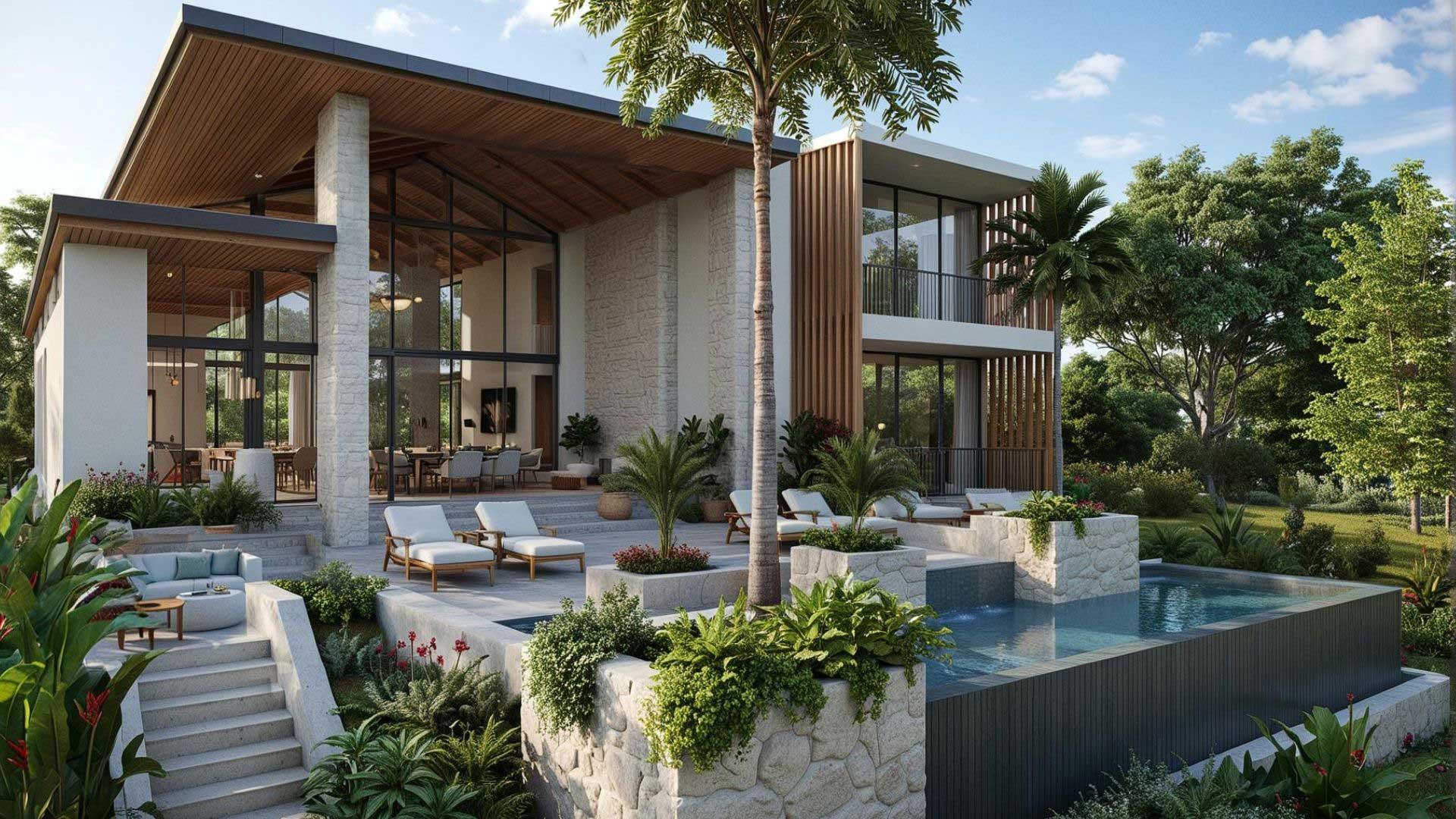
We start from the site. Before drawing, we survey the trees, the path of the sun and the prevailing wind, and we place the house so that daily life faces the green. These are the decisions that most shape how much nature a house lets in:
- Morning light in the bedrooms. East light at the start of the day helps set the body clock, and the afternoon sun stays on the other side of the house.
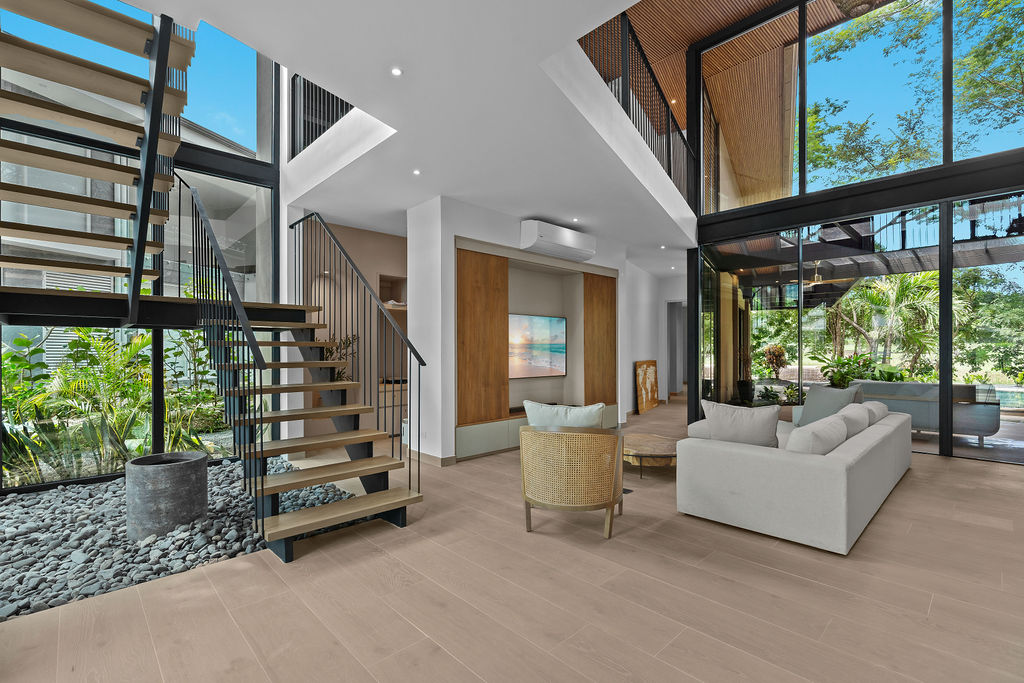
- Views to trees from the places where people spend hours: the bed, the desk, the kitchen, the dining table. Ulrich's patients benefited from a view alone.
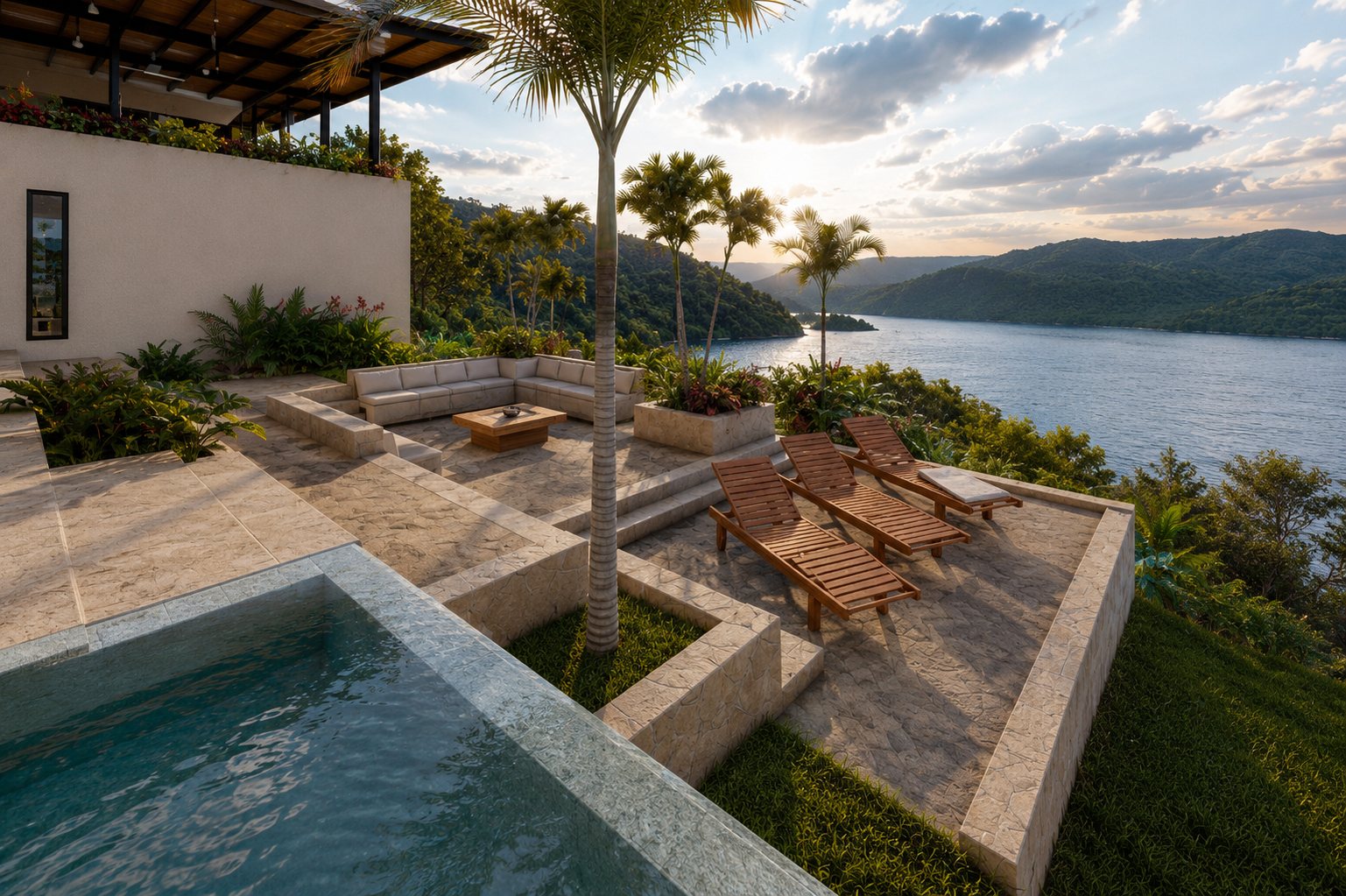
- Terraces that work as rooms, covered and wide enough to eat, work or rest outdoors. That is how the 120 minutes a week happen without planning them.
- Deep eaves and shade that let daylight in and keep direct sun and heat out, as we did at Käza House in Puerto Viejo de Guanacaste.
- Existing trees kept, and a garden of native species that brings birds, shade and the smell of the forest close to the house. At Villa Viva in Playa Grande, the hammocks hang between dry forest trees that were kept.
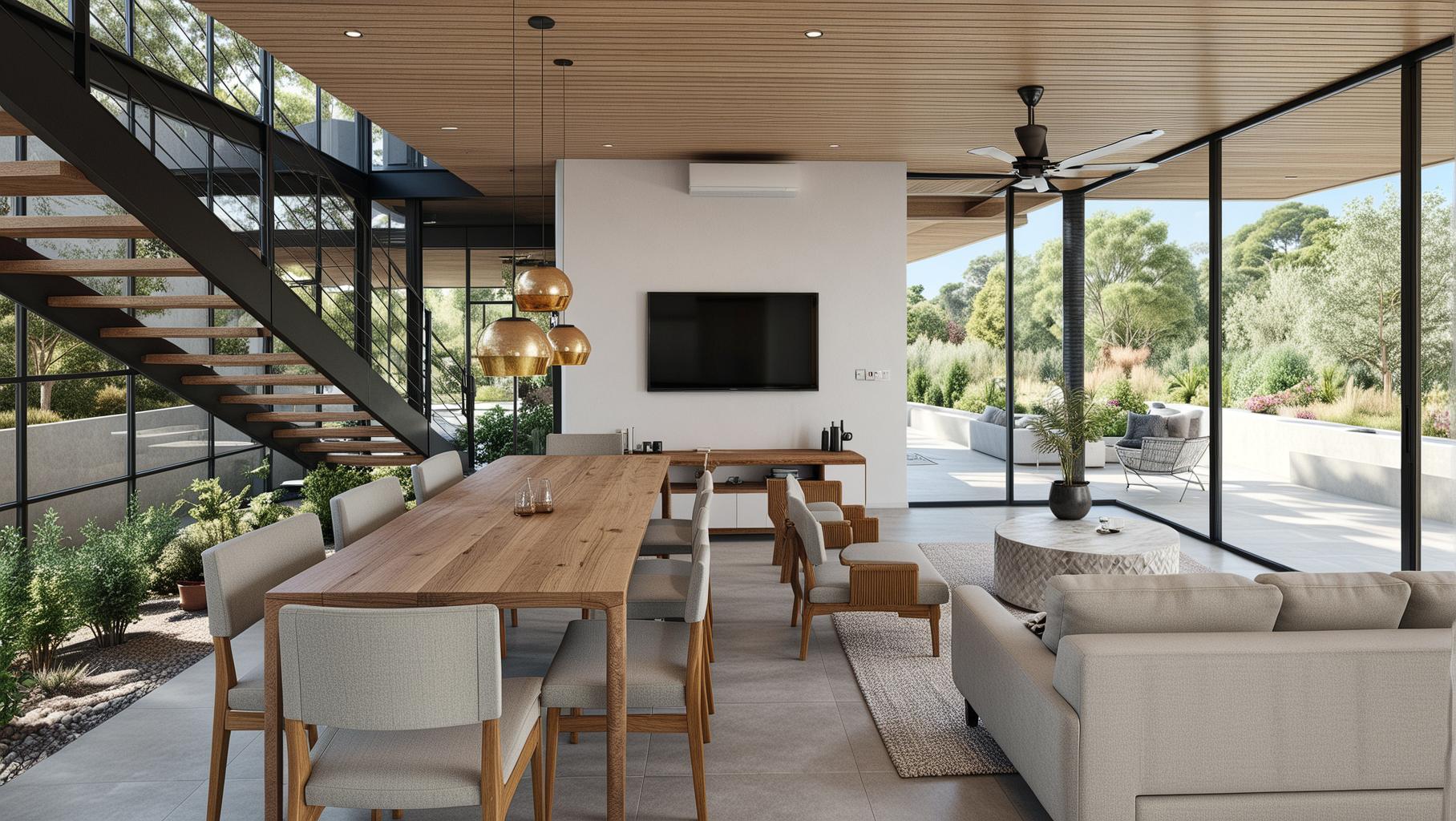
- Cross ventilation, so the house breathes with the outside air instead of closing against it.
Each of these points connects with other parts of our work: how a house opens to the outdoors is covered in our article on indoor and outdoor living in a tropical house, orientation and shade in bioclimatic architecture in Costa Rica, and the garden in landscape and architecture together. Our landscape design service draws the planting and the house together from the first plans.
Frequently asked questions
- Ulrich, R. S. (1984). View through a window may influence recovery from surgery. Science, 224(4647), 420-421. doi:10.1126/science.6143402
- Park, B. J., et al. (2010). The physiological effects of Shinrin-yoku: evidence from field experiments in 24 forests across Japan. Environmental Health and Preventive Medicine, 15. doi:10.1007/s12199-009-0086-9
- Li, Q., et al. (2008). Visiting a forest, but not a city, increases human natural killer activity and expression of anti-cancer proteins. International Journal of Immunopathology and Pharmacology, 21(1). doi:10.1177/039463200802100113
- Bratman, G. N., et al. (2015). Nature experience reduces rumination and subgenual prefrontal cortex activation. PNAS, 112(28). doi:10.1073/pnas.1510459112
- Berman, M. G., Jonides, J., & Kaplan, S. (2008). The cognitive benefits of interacting with nature. Psychological Science, 19(12). doi:10.1111/j.1467-9280.2008.02225.x
- White, M. P., et al. (2019). Spending at least 120 minutes a week in nature is associated with good health and wellbeing. Scientific Reports, 9, 7730. doi:10.1038/s41598-019-44097-3
- Twohig-Bennett, C., & Jones, A. (2018). The health benefits of the great outdoors: a systematic review and meta-analysis of greenspace exposure and health outcomes. Environmental Research, 166. doi:10.1016/j.envres.2018.06.030
- Engemann, K., et al. (2019). Residential green space in childhood is associated with lower risk of psychiatric disorders from adolescence into adulthood. PNAS, 116(11), 5188-5193. doi:10.1073/pnas.1807504116
- Klepeis, N. E., et al. (2001). The National Human Activity Pattern Survey (NHAPS). Journal of Exposure Analysis and Environmental Epidemiology, 11. doi:10.1038/sj.jea.7500165
- Boubekri, M., et al. (2014). Impact of windows and daylight exposure on overall health and sleep quality of office workers. Journal of Clinical Sleep Medicine, 10(6). doi:10.5664/jcsm.3780
- Lambert, G. W., et al. (2002). Effect of sunlight and season on serotonin turnover in the brain. The Lancet, 360(9348). doi:10.1016/S0140-6736(02)11737-5
- Beauchemin, K. M., & Hays, P. (1996). Sunny hospital rooms expedite recovery from severe and refractory depressions. Journal of Affective Disorders, 40(1-2). doi:10.1016/0165-0327(96)00040-7
- Lindqvist, P. G., et al. (2014). Avoidance of sun exposure is a risk factor for all-cause mortality: results from the Melanoma in Southern Sweden cohort. Journal of Internal Medicine, 276(1). doi:10.1111/joim.12251
- He, M., et al. (2015). Effect of time spent outdoors at school on the development of myopia among children in China. JAMA, 314(11). doi:10.1001/jama.2015.10803
- Wilson, E. O. (1984). Biophilia. Harvard University Press.
- Louv, R. (2005). Last Child in the Woods. Algonquin Books.
This article summarizes published research for general information and is not medical advice.